Tile Roof Replacement Cost in Florida (2026 Guide)
If you’ve got a quote in your hand and you’re wondering whether $28,000 is fair or $45,000 is too much, you’re in the right place. Tile roof replacement cost in Florida runs between $20,000 and $44,000 installed in 2026, depending on whether you choose concrete or clay and how big your roof is. A concrete tile roof on a typical 2,000-square-foot home costs $20,000 to $32,000. Clay tile runs higher – $27,700 to $44,000 – but it lasts decades longer.
The Orlando Roofing is a free matching service that connects homeowners with independent, licensed, insured contractors who replace tile roofs across Orlando and Central Florida every week. The prices below reflect typical 2026 Florida numbers, because a tile roof isn’t a product off a shelf, it’s a custom system built on your home, and online calculators miss most of what changes the price. Here’s what really drives your number.
One quick note: roofers price by the “square” — one square equals 100 square feet of roof surface. A typical home is 18 to 30 squares.
What Tile Roofs Actually Cost in Florida Right Now
Concrete Tile — The Smart Choice for Most Homes
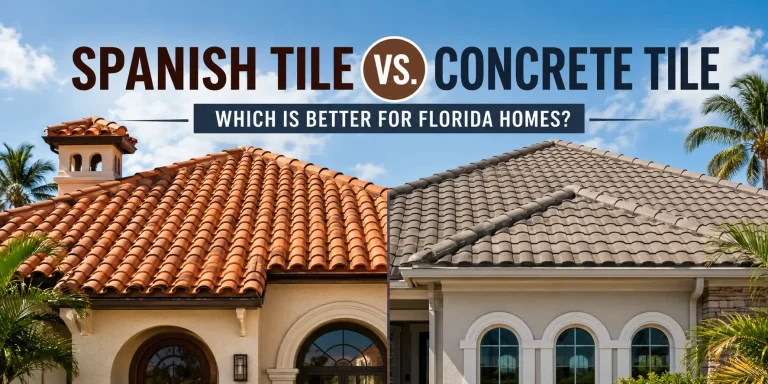
Concrete tile costs $10 to $16 per square foot installed about $20,000 to $32,000 for a 2,000-square-foot home. Most Florida tile roofs are actually concrete, and for good reason: it handles winds up to 125 mph, lasts 40 to 50 years, and comes in colors and profiles that most people can’t tell apart from far pricier clay. A concrete tile roof installed correctly will outlast two asphalt roofs and shrug off storms that strip shingles off neighboring homes. It isn’t a “cheap” material it’s a cost-effective one.
Clay Tile — The Roof That Lasts a Century
Clay tile costs $13.88 to $22 per square foot installed, about $27,700 to $44,000 for a 2,000-square-foot home. Clay is the classic Florida roof you see on 90-year-old Mediterranean homes, and installed properly, it can last 100 years while handling salt air, brutal sun, and winds over 140 mph.
The thing few contractors warn you about: clay is heavy. Many Florida homes, especially those built before the 1990s, need structural reinforcement before they can carry clay tile, and that can add $1,000 to $10,000. Some heavier concrete profiles can trigger the same review, so any honest tile quote starts with a structural check.
Tile Profiles & Styles Change the Price
Tile isn’t one product. The profile you choose moves your cost:
Profile also affects labor, because curved and interlocking tiles take more time to cut and fit around hips, valleys, and penetrations. When you compare quotes, make sure each one is pricing the same tile category and the same profile.
Your Location in Florida Changes the Price
Where you live matters as much as the tile you pick:
The spread comes from wind maps, local code, and what contractors must pay certified crews in each market. Pricing through our network reflects Orlando’s market, not a statewide or national average.
The Hidden Costs Nobody Tells You About
These aren’t contractor tricks — they’re real expenses that only show up once the old roof is off.
Decking Repairs — $4,000 to $6,000
Once the tile comes off, a contractor inspects the decking (the plywood or OSB beneath). In Florida’s humidity, a large share of older roofs need at least some decking replaced because of hidden rot. Each plywood sheet runs about $80 to $120 installed, which adds roughly $4,000 to $6,000 on a typical home. Always ask a contractor, “What’s your decking replacement rate per sheet, and how do you handle unexpected rot in the contract?” If they can’t answer clearly, keep looking.
Underlayment — Your Real Water Barrier
Florida’s climate now favors peel-and-stick underlayment for tile. It bonds to the deck, seals around nail holes, and keeps water out even if a tile cracks or blows off. Upgrading from basic felt adds about $400 to $1,200 and it’s worth it, because felt gets brittle in Florida heat and fails, which leads straight to that $4,000–$6,000 deck repair. Make sure your quote names the underlayment and its Florida Product Approval number.
Tear-Off
Florida code requires removal down to the wood deck you can’t layer new tile over old:
Tile is heavy, so disposal costs more than shingle.
Permits & State Surcharges
Permits run $200 to $800, and Florida adds small state surcharges (around 1–1.5% each) on top. On a $30,000 project, that’s roughly $750 in surcharges. A good contractor includes this if yours doesn’t, ask, and should pull every permit as a matter of course.
How Insurance Affects Your Tile Roof in 2026
This isn’t about installation cost directly, but it affects whether you can keep your coverage and what discounts you can earn.
Florida’s 15-Year Roof Rule
Under current Florida law: if your roof is under 15 years old, insurers can’t deny or cancel coverage just because of roof age. If it’s 15+ years old, they can require an inspection, and if a certified inspector confirms at least 5 years of useful life remaining, the carrier must renew. Recent law also requires many insurers to reimburse that inspection cost (commonly up to about $300) if your roof passes. Keep the report, it’s your proof if a carrier tries to drop you.
The 25% Rule
For older homes (generally those built before the 2007 Florida Building Code took effect) that have never been re-roofed, if a storm damages more than 25% of the roof, current code can require replacing the entire roof rather than patching the damaged section. A code update expected in late 2026 may change this. Confirm the current rule with your contractor before you assume either way.
Wind-Mitigation Discounts Are Real
Upgrading to impact-resistant tile, a sealed deck, and proper fasteners can cut your premium by 15% to 45%, depending on your carrier and location. After installation, ask for a wind-mitigation inspection, the report goes to your insurer, and the discount starts at your next renewal. If your roof was damaged in a storm, a good contractor documents everything and helps you through the claim, whether your policy pays Actual Cash Value (ACV) or Replacement Cost Value (RCV).
Seven Things That Move Your Tile Roof Price
- Roof size & steepness — Steep slopes (over 6/12) add about 20% to labor; very low slopes save ~10% on labor but add ~30% to underlayment. Slope alone can swing a 2,000 sq ft roof by $2,000–$3,000.
- Distance to the coast — Salt air means marine-grade materials and stainless fasteners. Within 10 miles of the coast can add ~20%; coastal location adds roughly $1,500–$3,000.
- Roof complexity — Multiple hips, valleys, dormers, skylights, and chimneys add 15–25% in labor for custom flashing and careful fitting.
- Access — Tight driveways, pool enclosures, and heavy landscaping add $500–$2,000 in setup and protection.
- Flashing & ventilation — New pipe boots, drip edge, valley metal, and ridge vents add $400–$1,500. These aren’t extras — they’re what makes a roof last.
- When you schedule — Winter (roughly January–March) runs about 15% cheaper with faster permits and crews; summer and storm season run 25–30% higher with backlogs.
- Labor availability — Labor is 40–60% of your total in Florida (versus ~30% nationally), and skilled tile crews are in short supply, so demand drives price.
How to Compare Tile Roof Quotes Without Getting Cheated
Got two or three estimates one $28,000, another $38,000? Lay them side by side and check each for these:
Why the lowest quote is usually the most expensive: low bids almost always skip one of these items. That missing underlayment or flashing doesn’t vanish, it returns as a change order after your old roof is already in the dumpster. If two quotes are thousands apart, they aren’t the same scope. Find out what’s missing first.
Questions to Ask Before You Sign
Tile vs. Other Florida Roofing Options
| Material | Cost (2,000 sq ft) | Florida lifespan | Insurance savings | Wind rating |
|---|---|---|---|---|
| Architectural shingles | $11,500 – $18,500 | 18–25 yrs | 10–25% | 110–130 mph |
| Concrete tile | $20,000 – $32,000 | 40–50 yrs | 15–30% | 125+ mph |
| Clay tile | $27,700 – $44,000 | 50–100+ yrs | 20–35% | 140+ mph |
| Standing seam metal | $36,000 – $49,000 | 50–70 yrs | 25–45% | 140+ mph |
The long-term math: a $25,000 tile roof that lasts 50 years costs about $500 a year. A $12,000 shingle roof that lasts 20 years costs about $600 a year and you replace it two or three times in the same span. Tile costs more upfront, but over decades it isn’t more expensive. The cost is just front-loaded.
Financing Your Tile Roof
A tile roof is a big investment, so you don’t have to pay it all at once. Many contractors offer financing options that let you spread the cost into manageable monthly payments, with plans ranging from short-term to longer terms. Ask about current options when you get your estimate, or budget first with our roof replacement cost calculator.