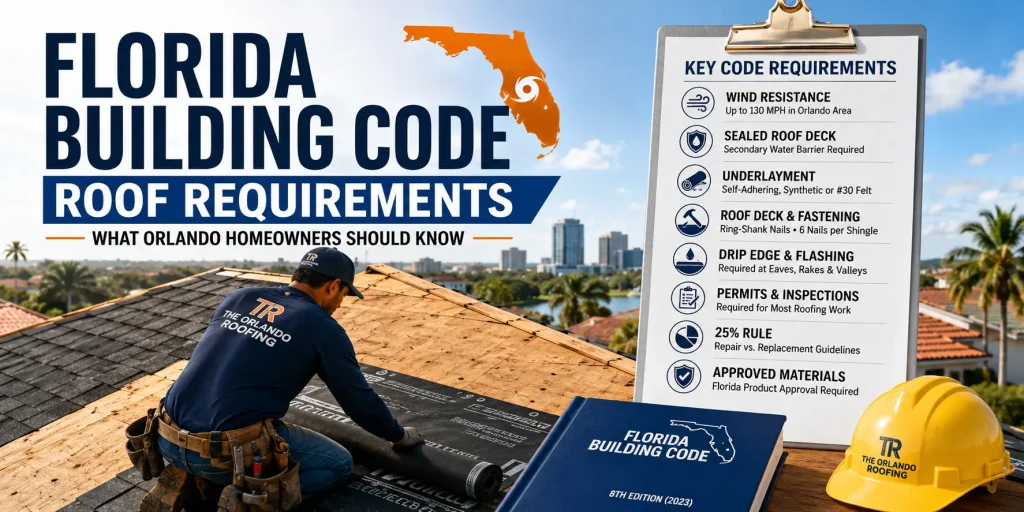
Florida Building Code Roof Requirements: What Orlando Homeowners Should Know
Florida building code roof requirements exist for one reason: hurricanes. After every major storm, the state tightens the rules for how roofs are built, fastened, and sealed, which is why the Florida Building Code is often called the gold standard for storm performance.
If you are planning a roof replacement, a repair, or even just want to understand what protects your home, knowing these rules helps you read a contractor’s quote, avoid failed inspections, and keep your insurance valid.
The Orlando Roofing is a free matching service that connects homeowners with independent, licensed, insured contractors who pull permits through Orange County and build to current code every week. Below is a plain English look at the main code requirements as they stand in 2026. Keep in mind that codes change, and your local building department always has the final say, so treat this as a guide and confirm the details for your project with your contractor.
Which Florida Building Code Applies in 2026?
For most of 2026, roofing work follows the Florida Building Code 8th Edition, which took effect on December 31, 2023, along with your local rules. A new version, the 9th Edition, takes effect on December 31, 2026. It adopts updated ASCE 7-22 wind maps, tightens fastening and sealed-deck rules, and further relaxes the 25 percent rule.
What this means in practice: if your permit is pulled before December 31, 2026, your project is generally handled under the current 8th Edition rules. Projects permitted after that date follow the 9th Edition. Your local building department, known as the Authority Having Jurisdiction or AHJ, decides what is required on your permit and what passes inspection. When there is any gray area, the AHJ is the final word.
Permits and Inspections
Almost all roofing work in Florida requires a permit. Full replacements always do, and most significant repairs do too. Small repairs that do not touch structure sometimes do not, but many homeowners still permit them to document the work. Your contractor should pull the permit and give you the permit number.
A permitted roof in Orange County usually involves at least two inspections: a dry-in inspection, after the deck is ready and the secondary water barrier is on but before the final material goes on, and a final inspection once the roof is complete. Skipping permits is a red flag. Unpermitted roofing work can cause problems at insurance renewal, at resale, and if anything goes wrong later. A good contractor handles all permitting as part of every job. You can learn more on our roof replacement page.
Wind Resistance Requirements
Wind resistance is the heart of the Florida roofing code. Requirements are based on the ASCE 7 wind maps, which assign a design wind speed to your location. Most of the Orlando area sits around the 130 mph design wind speed range for typical homes, though your exact number depends on your specific location and exposure. The 9th Edition adopts new ASCE 7-22 maps that can shift these numbers slightly.
One point that confuses many homeowners: the High Velocity Hurricane Zone, or HVHZ, with its extra-strict rules, only covers Miami-Dade and Broward counties. Orlando is not in the HVHZ. That does not mean weak rules here. Central Florida still has strong wind requirements built around the same goal of keeping the roof attached and the water out.
Sealed Roof Deck and Secondary Water Barrier
This is one of the most important rules. On a roof replacement, Florida requires an extra layer of water protection applied directly to the deck, under the shingles, tile, or metal. You may hear it called a sealed roof deck or a secondary water barrier. It is usually a self-adhering peel-and-stick membrane, or sealed tape over the deck seams combined with code-approved underlayment.
The idea is simple. If wind tears off the top layer of your roof in a storm, this barrier keeps rain out of your home until repairs can happen. It is installed during the dry-in stage, which is a required inspection point in most Orlando area jurisdictions. It also helps on insurance, since a sealed deck is one of the features that earns wind mitigation discounts.
Underlayment Requirements
Under your shingles or tile, the code requires underlayment, and in Florida, it is not just a single layer of thin felt anymore. Acceptable options include a self-adhering peel-and-stick membrane, a heavier minimum #30 felt that meets the standard for your slope, or a synthetic underlayment that meets the code’s strength and water resistance requirements.
The right choice depends on your roof covering and slope. When you review a quote, make sure it names the exact underlayment being used.
Roof Deck and Fastening
How the roof is attached matters as much as the materials. After the 2004 hurricane season, Florida began requiring ring-shank nails to attach the roof deck, the plywood or OSB under your covering, because they hold far better than smooth nails in high wind. Re-roofs commonly require the deck to be re-nailed to the current fastening schedule, with tighter spacing along the edges than in the middle. Decking is generally a minimum of 7/16 inch thick for most homes.
For the covering itself, the code sets fastener schedules by material and wind zone. For asphalt shingles in wind zones above 120 mph, which includes the Orlando area, that means six nails per shingle, not four. Tile is attached by an approved method, such as mortar, foam adhesive, or mechanical fasteners and screws, per the product’s approval.
Drip Edge, Flashing, and Valleys
The code also covers the details where leaks usually start. A metal drip edge is required along the eaves and rakes to keep wind-driven rain from getting under the edge. Flashing at walls, chimneys, vents, and skylights must meet set sizes and overlaps, since most long-term leaks begin at these transitions, not in the open field of the roof.
Valleys must use corrosion-resistant metal or approved materials at minimum widths, and a cricket is required behind any chimney or penetration wider than 30 inches to direct water around it.
The 25 Percent Rule
This rule decides when a repair becomes a bigger job. Under the Florida Building Code, Section 706, if more than 25 percent of a roof or a roof section is damaged within a 12 month period, that section may need to be brought up to current code, which can mean replacement.
There is an important exception from 2022. Under Senate Bill 4-D, if your roof was built or permitted to the 2007 Florida Building Code, which took effect March 1, 2009, or later, you generally only need to repair the damaged area, not the whole roof. The 9th Edition in late 2026 relaxes this further by allowing more partial recovery. Because this area changes, confirm how the rule applies to your home with your contractor and the AHJ. Our guide on tile roof repair vs. replacement covers the decision in more detail.
Roof-Over and Overlay Limits
Florida code allows a new roof over an old one only in limited cases. A home is allowed a maximum of two layers of asphalt shingles, so if you already have two, a full tear-off to the deck is required. Tile, slate, clay, wood shake, and metal roofs require a tear-off rather than an overlay, and any deck that is water-soaked or deteriorated must be torn off as well.
Even when an overlay is allowed, most experienced roofers recommend a full tear-off, because it lets them inspect the deck, fix hidden damage, and install a proper sealed deck and underlayment. Overlays can also reduce or void manufacturer warranties.
Approved Materials: Florida Product Approval
Every roofing material used in Florida must carry a Florida Product Approval, which shows it has been tested and approved for use here. In the HVHZ counties, a Miami-Dade Notice of Acceptance is often required. When you review a quote, you can ask for the product approval numbers for the exact materials being installed. A material without proper approval can fail inspection.
How Code Compliance Affects Your Insurance
Meeting code does more than pass inspection. Code-compliant features like a sealed roof deck, a secondary water barrier, and strong fastening are exactly what wind mitigation inspections reward, and they can lower your premium by roughly 20 to 45 percent depending on your carrier.
Many Florida policies also include Ordinance or Law coverage, which can help pay for required code upgrades after a covered loss. Ask your contractor for a wind mitigation inspection after the work is done so you can claim those savings.
What This Means for Your Orlando Roof
The takeaway is simple. Florida’s roofing code is the floor for a safe roof, not the ceiling. A roof built to current code stays attached in high wind, keeps water out when the top layer is damaged, and protects your insurance and resale value.
The best way to know where your roof stands, and what code will require for any work, is a professional roof inspection. A good contractor will check your roof, explain what applies to your home, and handle the permits and inspections from start to finish. For storm-season readiness, see our hurricane preparation guide.